
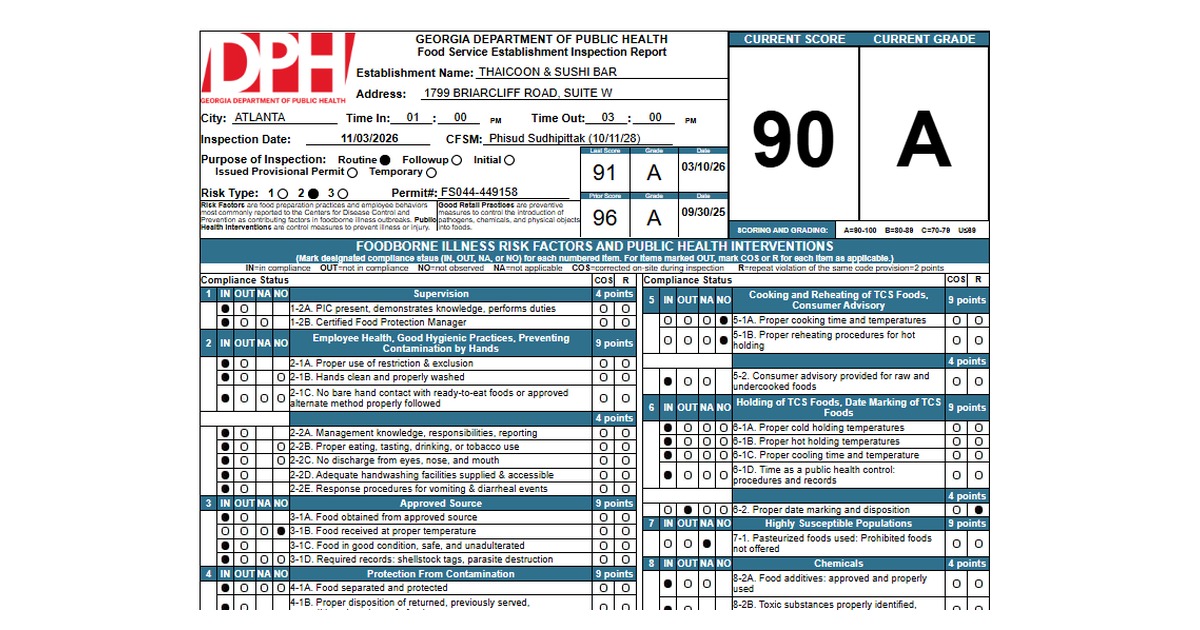
THAICOON & SUSHI BAR received a score of 90 and a grade of A during a Georgia Department of Public Health inspection conducted November 3, 2026. The score reflects conditions observed during that inspection.
Inspection details
Establishment: THAICOON & SUSHI BAR
Location: 1799 BRIARCLIFF ROAD, SUITE W ATLANTA, GA 30306, DeKalb County
Inspection date: November 3, 2026
Inspection purpose: Routine
Score and grade: 90/A
Inspector: Curtis Fritts
Permit number: FS044-449158
Inspection findings
6-2 – proper date marking and disposition
Rule citation: 511-6-1.04(6)(g) – ready-to-eat time/temperature control for safety food, date marking (pf)
Official point value: 4
Corrected during inspection: No
Repeat violation: Yes
Inspector notes and corrective action: Curry sauce holding inside of the prep top cooler #1 has the incorrect date of preparation and no discard date on the outside of container. COS. Correct date was placed on container. 511-6-1.04(6)(g) – Ready-To-Eat Time/Temperature Control for Safety Food, Date Marking (Pf) (g) Ready-to-Eat Time/Temperature Control for Safety Food, Date Marking 1. Except when packaging food using a reduced oxygen packaging method, and except as specified in paragraphs 5 and 6 of this subsection, refrigerated, ready-to-eat, time/temperature control for safety food prepared and held in a food establishment for more than 24 hours shall be clearly marked to indicate the date or day by which the food shall be consumed on the premises, sold, or discarded, when held at a temperature of 41°F (5°C) or below for a maximum of 7 days. The day of preparation shall be counted as Day 1. Pf 2. Except as specified in paragraphs 5 through 7 of this subsection, refrigerated, ready-to-eat, time/temperature control for safety food prepared and packaged by a food processing plant shall be clearly marked, at the time the original container is opened in a food service establishment and if the food is held for more than 24 hours, to indicate the date or day by which the food shall be consumed on the premises, sold, or discarded, when held at a temperature of 41°F (5°C) or below for a maximum of 7 days after the original container is opened. The day the original container is opened in the food service establishment shall be counted as Day 1, except, the day or date marked by the food service establishment may not exceed a manufacturer’s use by date if the manufacturer determined the use-by date based on food safety; Pf 3. A refrigerated, ready-to-eat, time/temperature control for safety food ingredient or a portion of a refrigerated, ready-to-eat, time/temperature control for safety food that is subsequently combined with additional ingredients or portions of food shall retain the date marking of the earliest-prepared or first-prepared ingredient. Pf 4. A date marking system that meets the criteria stated in paragraphs 1 and 2 of this subsection may include: (i) Using a method approved by the Health Authority for refrigerated, ready-to-eat time / temperature control for safety food that is frequently rewrapped, such as lunchmeat or a roast, or for which date marking is impractical, such as soft serve mix or milk in a dispensing machine; (ii) Marking the date or day of preparation, with a procedure to discard the food on or before the last date or day by which the food must be consumed on the premises, sold, or discarded; (iii) Marking the date or day the original container is opened in a food service establishment, with a procedure to discard the food on or before the last date or day by which the food must be consumed on the premises, sold, or discarded; or (iv) Using calendar dates, days of the week, color-coded marks, or other effective marking methods, provided that the marking system is disclosed to the Health Authority upon request. 5. The requirements in paragraphs 1 and 2 of this subsection do not apply to individual meal portions served or repackaged for sale from a bulk container upon a consumer’s request. 6. The requirements in paragraphs 1 and 2 of this subsection do not apply to shellstock. 7. The requirement in paragraph 2 of this subsection does not apply to the following foods prepared and packaged by a food processing plant inspected by a Health Authority: (i) Deli salads, such as ham salad, seafood salad, chicken salad, egg salad, pasta salad, potato salad, and macaroni salad, manufactured in accordance with 21 CFR 117 Current good manufacturing practice in manufacturing, packing, or holding human food; (ii) Hard cheeses containing not more than 39% moisture as defined in 21 CFR 133 Cheeses and related cheese products, such as cheddar, gruyere, parmesan and reggiano, and romano; (iii) Semi-soft cheeses containing more than 39% moisture, but not more than 50% moisture, as defined in 21 CFR 133 Cheeses and related cheese products, such as blue, edam, gorgonzola, gouda, and monterey jack; (iv) Cultured dairy products as defined in 21 CFR 131 Milk and cream, such as yogurt, sour cream, and buttermilk; (v) Preserved fish products, such as pickled herring and dried or salted cod, and other acidified fish products defined in 21 CFR 114 Acidified foods; (vi) Shelf stable, dry fermented sausages, such as pepperoni and Genoa salami; and (vii) Shelf stable salt-cured products, such as prosciutto and Parma ham.
12C – wiping cloths: properly used and stored
Rule citation: 511-6-1.04(4)(m) – wiping cloths, use limitation (c)
Official point value: 3
Corrected during inspection: Yes
Repeat violation: No
Inspector notes and corrective action: Observed wiping cloth solution not at minimum strength. Observed chlorine above 300 ppm. COS water was discarded and the proper strength added.511-6-1.04(4)(m) – Wiping Cloths, Use Limitation (C) (m) Wiping Cloths, Use Limitation. 1. Cloths in-use for wiping food spills from tableware and carry-out containers that occur as food is being served shall be: (i) Maintained dry; and (ii) Used for no other purpose. 2. Cloths in-use for wiping counters and other equipment surfaces shall be: (i) Held between uses in a chemical sanitizer solution at a concentration specified under DPH Rule 511-6-1-.05(6)(n); and (ii) Laundered daily. 3. Cloths in-use for wiping surfaces in contact with raw animal foods shall be kept separate from cloths used for other purposes. 4. Dry wiping cloths and the chemical sanitizing solutions in which wet wiping cloths are held between uses shall be free of food debris and visible soil. 5. Containers of chemical sanitizing solutions in which wet wiping cloths are held between uses shall be stored off the floor and used in a manner that prevents contamination of food, equipment, utensils, linens, single-service, or single-use articles. 6. Single-use disposable sanitizer wipes shall be used in accordance with EPA-approved manufacturer’s label use instructions
17C – physical facilities installed, maintained, and clean
Rule citation: 511-6-1.07(2)(d) – floor carpeting, restrictions & installation (c)
Official point value: 1
Corrected during inspection: No
Repeat violation: No
Inspector notes and corrective action: Carpeting upon entrance to food preparation area and next to sushi bar is unclean and has a sticky substance when walking over the floor.511-6-1.07(2)(d) – Floor Carpeting, Restrictions & Installation (C) (d) Floor Carpeting, Restrictions and Installation. 1. A floor covering such as carpeting or similar material may not be installed as a floor covering in food preparation areas, walk-in refrigerators, warewashing areas, toilet room areas where handwashing sinks, toilets, and urinals are located, refuse storage rooms, or other areas where the floor is subject to moisture, flushing, or spray cleaning methods. 2. If carpeting is installed as a floor covering in areas other than those specified under paragraphs 1 of this subsection, it shall be: (i) Securely attached to the floor with a durable mastic, by using a stretch and tack method, or by another method; and (ii) Installed tightly against the wall under the coving or installed away from the wall with a space between the carpet and the wall and with the edges of the carpet secured by metal stripping or some other means.
General inspector comments
Observances : Most recent parasite destruction letters from KGI Trading GA and East Sea Trading Co Employee Illness quick decision guide for food establishment person in charge. Georgia conditional employee or food employee reporting agreement. Implementation of an effective employee health policy procedures. Observed raw meat advisory on menu. Dishmachine – chlorine 150 ppm. Wiping cloths – Chlorine – 150 ppm.
About the report
The Georgia Department of Public Health report documents conditions observed during this inspection. The score should not be interpreted as a guarantee of conditions before or after the inspection.
Marcus Jones
News Now Georgia
More DeKalb County Food Safety Scores
View All DeKalb County Food Safety Scores