
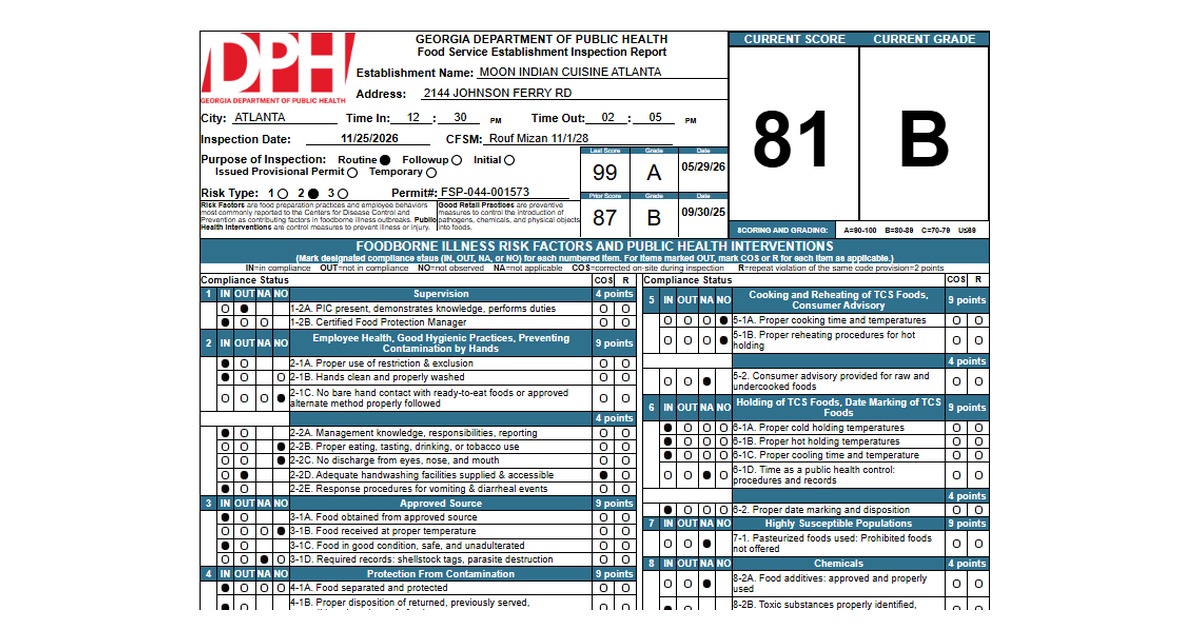
MOON INDIAN CUISINE ATLANTA received a score of 81 and a grade of B during a Georgia Department of Public Health inspection conducted November 25, 2026. The score reflects conditions observed during that inspection.
Inspection details
Establishment: MOON INDIAN CUISINE ATLANTA
Location: 2144 JOHNSON FERRY RD ATLANTA, GA 30319, DeKalb County
Inspection date: November 25, 2026
Inspection purpose: Routine
Score and grade: 81/B
Inspector: Ashley Albert
Permit number: FSP-044-001573
Inspection findings
1-2A – pic present, demonstrates knowledge, performs duties
Rule citation: 511-6-1.03(2) – pic present (pf)
Official point value: 4
Corrected during inspection: No
Repeat violation: No
Inspector notes and corrective action: No manager was on site at the time of inspection. CA:There must be a person in charge on the premises of the food service establishment at all times. The person in charge shall ensure compliance with the following: Advised the facility to designate a PIC and have that individual on site during all hours of operation.
2-2D – adequate handwashing facilities supplied & accessible
Rule citation: 511-6-1.06(2)(o) – using a handwashing sink- operation & maintenance (pf)
Official point value: 4
Corrected during inspection: Yes
Repeat violation: No
Inspector notes and corrective action: Observed two pans stored in the main kitchen handwashing sink at the time of inspection. CA: (o) Using a Handwashing Sink. 1. A handwashing sink shall be maintained so that it is accessible at all times for employee use. Pf 2. A handwashing facility may not be used for purposes other than handwashing. Pf 3. An automatic handwashing facility shall be used in accordance with manufacturer’s instructions. Pf COS: Staff removed both pans from the handwashing sink during the inspection.
4-2B – food-contact surfaces: cleaned & sanitized
Rule citation: 511-6-1.05(6)(n) – manual and mechanical warewashing equipment, chemical sanitization-temperature, ph, concentration, hardness (p,pf)
Official point value: 4
Corrected during inspection: No
Repeat violation: No
Inspector notes and corrective action: Observed that no sanitizer was available for dishes, utensils, or food-contact surfaces at the time of inspection. CA:(n) Manual and Mechanical Warewashing Equipment, Chemical Sanitization – Temperature, pH, Concentration, and Hardness. A chemical sanitizer used in a sanitizing solution for a manual or mechanical operation at contact times specified under subsection (8)(b)3 of this Rule shall meet the requirements specified in DPH Rule 511-6-1-.07(6)(g), shall be used in accordance with the Environmental Protection Agency (EPA)-registered label use instructions P, and shall be used as follows: 1. A chlorine solution shall have a minimum temperature based on the concentration and pH of the solution as listed in the following chart; P Concentration Range Minimum Temperature MG/L PH 10 or less oF (oC) PH 8 or less oF (oC) 25-49 120 (49) 120 (49) 50-99 100 (38) 75 (24) 100 55 (13) 55 (13) 2. An iodine solution shall have a minimum temperature of 68°F (20°C)P minimum concentration between 12.5 ppm and 25 ppm, P and pH of 5.0 or less or a pH no higher than the level for which the manufacturer specifies for the solution to be effective; P 3. A quaternary ammonium compound solution shall have a minimum temperature of 75ºF (24ºC), P have a concentration as specified in DPH Rule 511-6-1-.07(6)(g) and as indicated by the manufacturer’s use directions included in the labeling, P and be used only in water with 500 ppm hardness or less or in water having a hardness no greater than specified by the EPA-registered label use instructions; P 4. If another solution of a chemical specified under paragraphs 1 through 3 of this subsection is used, the permit holder shall demonstrate to the Health Authority that the solution achieves sanitization and the use of the solution shall be approved; P 5. If a chemical sanitizer other than chlorine, iodine, or a quaternary ammonium compound is used, it shall be applied in accordance with the EPA-registered label use instructions ;P and 6. If a chemical sanitizer is generated by a device located on-site at the food service establishment, it shall be used as specified in 1-5 of this subsection and shall be produced by a device that: (i) complies with law as specified in sections 2(q)(1) and 12 of the Federal Insecticide, Fungicide, and Rodenticide Act (FIFRA), P (ii) complies with 40 CFR 152.500 Requirement for Devices and 40 CFR 156.10 Labeling Requirements, P (iii) displays the EPA device manufacturing facility registration number on the device, Pf and (iv) is operated and maintained in accordance with manufacturer’s instructions. Pf. 7. On-site chemical sanitizer generating equipment with active ingredients, such as copper, must be registered as pesticides. The active ingredient may be part of the equipment or separately added. Advised the facility to obtain an approved food-contact surface sanitizer and use it according to the label directions after washing and rinsing dishes, utensils, and food-contact surfaces.
12A – contamination prevented during food preparation, storage, display
Rule citation: 511-6-1.04(4)(q) – food storage (c)
Official point value: 3
Corrected during inspection: Yes
Repeat violation: No
Inspector notes and corrective action: Observed lentils cooling in a container placed directly on the floor and an unclean pot stored directly on the floor in the main kitchen. Containers of whole tomatoes and cut jalapeños were stored underneath the prep-top cooler in main kitchen at the time of inspection. CA: (q) Food Storage. 1. Except as specified in paragraphs 2 and 3 of this subsection, food shall be protected from contamination by storing the food: (i) In a clean, dry location; (ii) Where it is not exposed to splash, dust, or other contamination; and (iii) At least 6 inches (15 cm) above the floor. 2. Food in packages and working containers may be stored less than 6 inches (15 cm) above the floor on case lot handling equipment if the equipment can be moved by hand or by conveniently available apparatuses such as hand trucks and forklifts. 3. Pressurized beverage containers, cased food in waterproof containers such as bottles or cans, and milk containers in plastic crates may be stored on a floor that is clean and not exposed to floor moisture. COS: During the inspection, staff moved the lentils, to designated areas off the floor and removed the unclean pot from the floor. Staff discarded the whole tomatoes and cut jalapeños that were stored underneath the prep-top cooler during the inspection.
15A – food and nonfood-contact surfaces cleanable, properly designed, constructed, and used
Rule citation: 511-6-1.05(6)(a) – good repair & proper adjustment (c)
Official point value: 1
Corrected during inspection: No
Repeat violation: No
Inspector notes and corrective action: Observed an ambient temperature of 45F in the walk-in cooler at the time of inspection. CA: (6) Maintenance and Operation. (a) Good Repair and Proper Adjustment. 1. Equipment shall be maintained in a state of repair and condition that meets the requirements specified under subsections (1) and (2)of this Rule. 2. Equipment components such as doors, seals, hinges, fasteners, and kick plates shall be kept intact, tight, and adjusted in accordance with manufacturer’s specifications. 3. Cutting or piercing parts of can openers shall be kept sharp to minimize the creation of metal fragments that can contaminate food when the container is opened. During the inspection, the employee removed TCS foods from the walk-in cooler and transferred them to a separate cooler.
15B – warewashing facilities: installed, maintained, used; test strips
Rule citation: 511-6-1.05(2)(y),(z),(aa),(bb) – warewashing machine, data plate, internal baffles, temperature md, heaters & baskets (pf, c)
Official point value: 1
Corrected during inspection: No
Repeat violation: No
Inspector notes and corrective action: The dishmachine failed to achieve a chlorine sanitizer concentration of 50–100 ppm at the time of inspection. CA: (y) Warewashing Machine, Data Plate Operating Specifications. A warewashing machine, if utilized, shall be provided with an easily accessible and readable data plate affixed to the machine by the manufacturer that indicates the machine’s design and operating specifications including the: 1. Temperatures required for washing, rinsing, and sanitizing; 2. Pressure required for the fresh water sanitizing rinse unless the machine is designed to use only a pumped sanitizing rinse; and 3. Conveyor speed for conveyor machines or cycle time for stationary rack machines. (z) Warewashing Machines, Internal Baffles. Warewashing machine wash and rinse tanks shall be equipped with baffles, curtains, or other means to minimize internal cross contamination of the solutions in wash and rinse tanks. (aa) Warewashing Machines, Temperature Measuring Devices. A warewashing machine shall be equipped with a temperature measuring device that indicates the temperature of the water: 1. In each wash and rinse tank; Pf and 2. As the water enters the hot water sanitizing final rinse manifold or in the chemical sanitizing solution tank. Pf (bb) Manual Warewashing Equipment, Heaters and Baskets. If hot water is used for sanitization in manual warewashing operations, the sanitizing compartment of the sink shall be: 1. Designed with an integral heating device that is capable of maintaining water at a temperature not less than 171ºF (77ºC); Pf and 2. Provided with a rack or basket to allow complete immersion of equipment and utensils into the hot water. Pf Advised the facility to service the dishmachine and verify the chlorine concentration with test strips before resuming use. In the meantime, advised the facility to wash, rinse, and sanitize dishes and utensils in the three-compartment sink.
18 – insects, rodents, and animals not present
Rule citation: 511-6-1.07(2)(n) – exterior walls and roofs, protective barrier (c)
Official point value: 3
Corrected during inspection: No
Repeat violation: No
Inspector notes and corrective action: Observed an opening in the roof of the exterior kitchen at the time of inspection. CA: (n) Exterior Walls and Roofs, Protective Barrier. Perimeter walls and roofs of a food service establishment shall effectively protect the establishment from the weather and the entry of insects, rodents, and other animals. Advised the facility to repair and seal the opening to prevent pest entry and protect food and equipment from weather and debris.
18 – insects, rodents, and animals not present
Rule citation: 511-6-1.07(2)(m) – outer openings protected (c)
Official point value: 3
Corrected during inspection: No
Repeat violation: No
Inspector notes and corrective action: Observed an opening in the door or fence enclosing the exterior kitchen at the time of inspection. CA:(m) Outer Openings, Protected. 1. Except as specified in paragraphs 2 through 5 of this subsection, outer openings of a food service establishment shall be protected against the entry of insects and rodents by: (i) Filling or closing holes and other gaps along floors, walls, and ceilings; (ii) Closed, tight-fitting windows; and (iii) Solid, self-closing, tight-fitting doors. 2. The requirements in paragraph 1 of this subsection does not apply if a food service establishment opens into a larger structure, such as a mall, airport, or office building, or into an attached structure, such as a porch, and the outer openings from the larger or attached structure are protected against the entry of insects and rodents. 3. Exterior doors used as exits need not be self-closing if they are: (i) Solid and tight-fitting; (ii) Designated for use only when an emergency exists, by the fire protection authority that has jurisdiction over the food establishment; and (iii) Limited-use so they are not used for entrance or exit from the building for purposes other than the designated emergency exit use. 4. Except as specified in paragraphs 2 and 5 of this subsection, if the windows or doors of a food service establishment, or of a larger structure within which a food service establishment is located, are kept open for ventilation or other purposes or a temporary food service establishment is not provided with windows and doors as specified under paragraph 1 of this subsection, the openings shall be protected against the entry of insects and rodents by: (i) 16 mesh to 1 inch (16 mesh to 25.4 mm) screens; (ii) Properly designed and installed air curtains to control flying insects; or (iii) Other effective means. 5. The requirement in paragraph 4 of this subsection does not apply if flying insects and other pests are absent due to the location of the establishment, the weather, or other limiting condition. Advised the facility to repair and close the opening to prevent pest entry.
General inspector comments
Thermometers calibrated on site 32F (Thermopop, thermapen, deltatrak)
About the report
The Georgia Department of Public Health report documents conditions observed during this inspection. The score should not be interpreted as a guarantee of conditions before or after the inspection.
Marcus Jones
News Now Georgia
More DeKalb County Food Safety Scores
View All DeKalb County Food Safety Scores

