
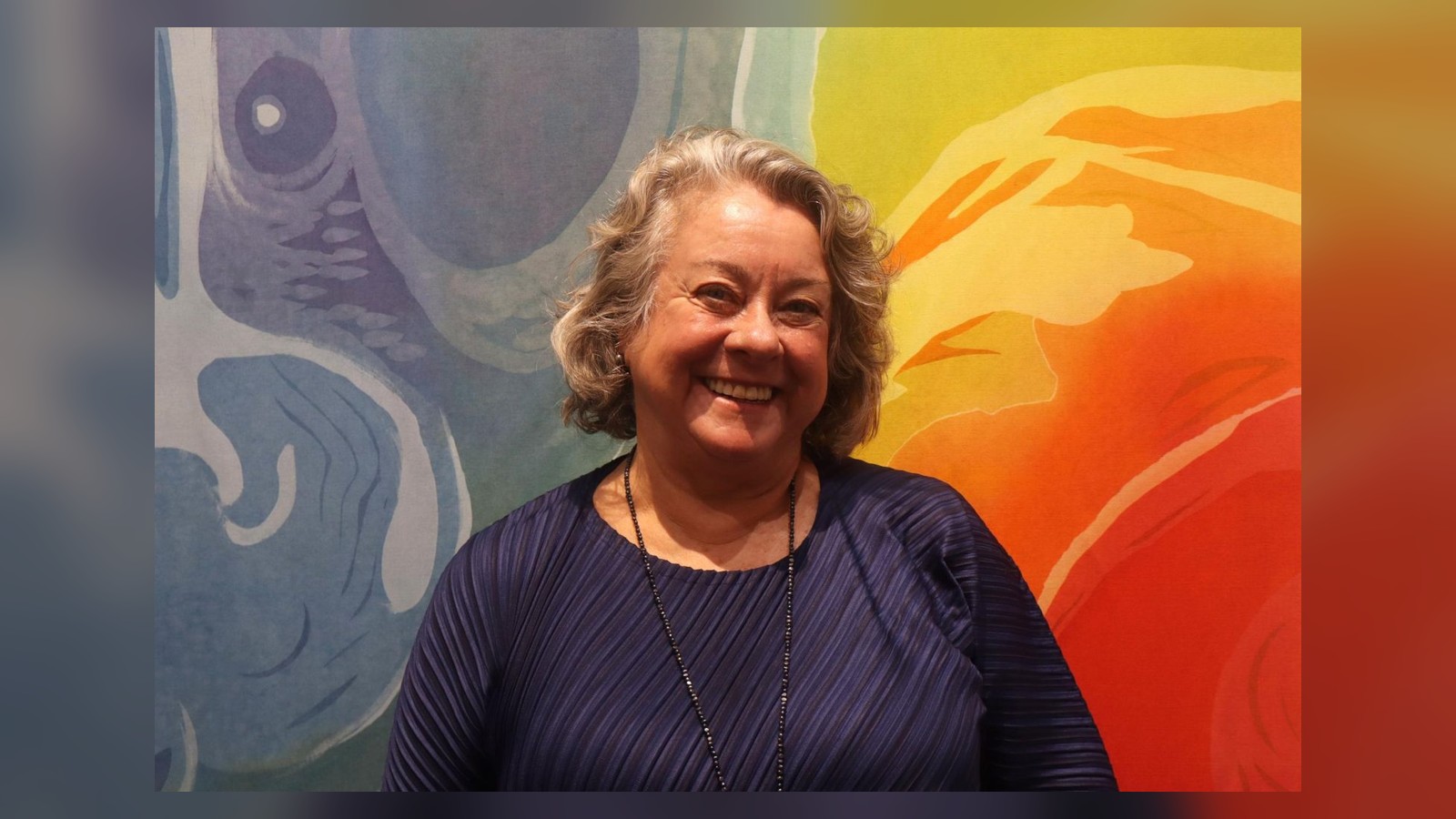
Mary Edna Fraser’s exhibition Above Between Below gathers work from across her career at the Museum of Arts and Sciences in Macon, with the show on display through Jan. 9, 2027. The paintings bring together landscapes, scientific findings and personal experiences, reflecting an artist who uses aerial views to explore the environment.
Fraser is a South Carolina-based environmental activist artist known for large-scale silk and oil paintings shaped by aerial photography, research and the land itself. She first recognized the artistic possibilities of Georgia’s coastline during a flight there in the mid-1970s. Since then, she has photographed landscapes across the western United States and flown along the East Coast. When she travels beyond her home region, she rents planes with instructors. She says seeing land from above helps her consider what improper development could affect.
Her path to this work was not direct. Fraser once expected to become a full-time folk musician. In the 1970s, Sister Ramy, a nun at a craft school, saw her ability with batik and urged her to pursue it. Batik creates patterns on cloth with wax and dye.
Fraser grew up in North Carolina, spending much of her childhood outdoors. Her mother taught her about flowers, trees and stars; her father was a Boy Scout leader and master pilot. Fraser began drawing birds and animals at 11. Her family’s 1946 Aircoupe, inherited from her grandfather, helped shape her view of Earth as an artistic subject.
To make a batik painting, Fraser sketches an aerial photograph on silk, then applies heated beeswax and paraffin before dyeing exposed sections in successive layers. She stretches the silk between sawhorses and paints dye onto both sides while lying on her back. To set the dye, Fraser puts paper on either side of the silk and presses it with an iron. She can spend six weeks or more on one of the larger works.
The finished work may depart from the photograph: Fraser sometimes changes rivers, islands and colors. During the process, she has said, waxed silk viewed upside down and backward can resemble four abstract paintings. She decides a piece is complete by instinct, when it feels balanced and right.
Fraser began seeking a stronger connection between science and beauty in 1994, while preparing for a solo exhibition at the Smithsonian National Air and Space Museum. She contacted a Duke University scientist who studied barrier islands. Their collaboration led to a research voyage and a book, and the 10-year project identified 2,200 barrier islands. Fraser believes art can help people connect emotionally with issues such as sea-level rise and global climate change. Her work Inferno, inspired by a wildfire in Glacier National Park, depicts the fire in a visually striking composition.
Her environmental work also extends beyond the studio. Fraser works with South Carolina organizations opposing developments she says threaten wetlands, waterways and communities. Through her website, Delete Apathy, she shares information and encourages public involvement; she has also advocated against highways through communities and environmentally sensitive areas. She is fighting a proposed development near the Edisto River that includes a data center and gas plant, which she fears could threaten the surrounding ecosystem.
Fraser says seeing decades of her work together in Macon makes her happy. She hopes visitors look beyond the technical skill, see each piece as a visual prayer, and leave with a sense of peace, love and connection to the planet’s beauty.

Sarah Whitmore
News Now Georgia


