
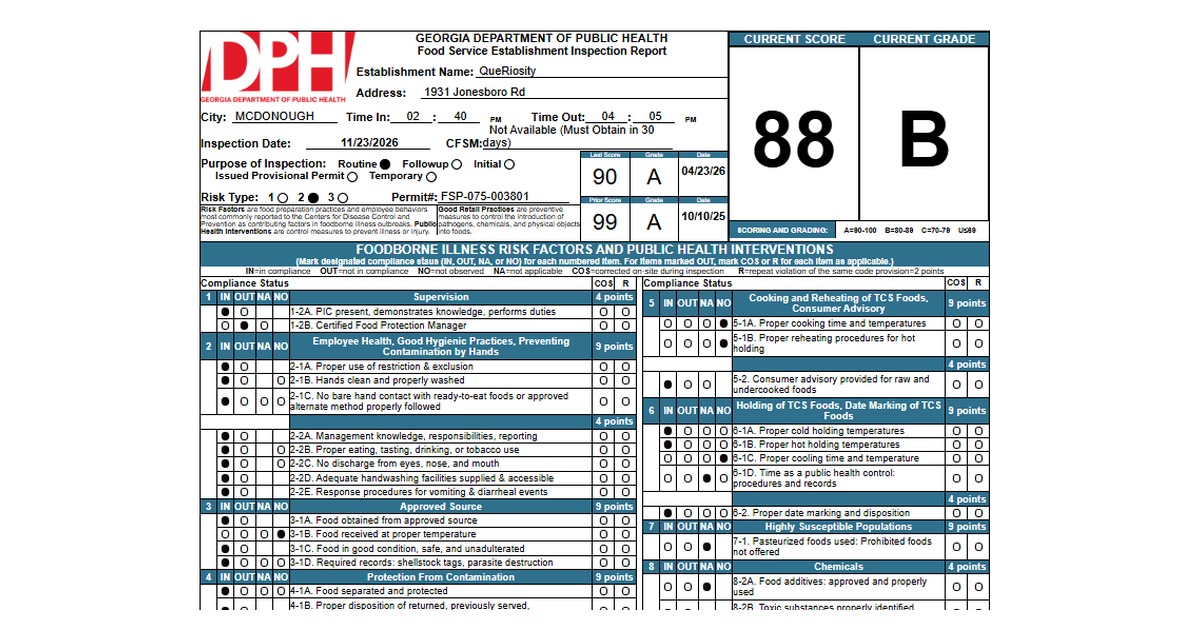
QueRiosity received a score of 88 and a grade of B during a Georgia Department of Public Health inspection conducted November 23, 2026. The score reflects conditions observed during that inspection.
Inspection details
Establishment: QueRiosity
Location: 1931 JONESBORO RD MCDONOUGH, GA 30253, Henry County
Inspection date: November 23, 2026
Inspection purpose: Routine
Score and grade: 88/B
Inspector: Rachel Williams
Permit number: FSP-075-003801
Inspection findings
1-2B – certified food protection manager
Rule citation: 511-6-1.03(3)(a) – food safety manager certification (pf)
Official point value: 4
Corrected during inspection: No
Repeat violation: No
Inspector notes and corrective action: Observed no certified food safety manager within the employ of the facility. PIC advised that she was in the process of obtaining her certification. 511-6-1.03(3)(a) – Food Safety Manager Certification (Pf) Food service establishments shall have in its employ a Certified Food Safety Manager (CFSM) as specified in paragraph (b) of this subsection to ensure food safety is being managed within the food service establishment during all hours of operation as specified within paragraph (d) of this subsection. Pf
4-2B – food-contact surfaces: cleaned & sanitized
Rule citation: 511-6-1.05(6)(n) – manual and mechanical warewashing equipment, chemical sanitization-temperature, ph, concentration, hardness (p,pf)
Official point value: 4
Corrected during inspection: No
Repeat violation: No
Inspector notes and corrective action: Observed dish machine utilizing chlorine sanitizer at 0 ppm. PIC was advised to discontinue use of the machine until completely repaired.
4-2B – food-contact surfaces: cleaned & sanitized
Rule citation: 511-6-1.05(7)(b) – food contact surfaces and utensils – cleaning frequency (p, c)
Official point value: 4
Corrected during inspection: No
Repeat violation: No
Inspector notes and corrective action: Observed ice machine at the bar with accumulation and food debris on interior door. (b) Equipment Food-Contact Surfaces and Utensils. 1. Equipment food-contact surfaces and utensils shall be cleaned: (i) Before each use with a different type of raw animal food such as beef, fish, lamb, pork, or poultry. It does not apply if the food-contact surface or utensil is in contact with a succession of different types of raw meat and raw poultry each requiring a higher cooking temperature as specified under DPH Rule 511-6-1.04(5)(a) than the previous type such as preparing raw pork followed by cutting raw poultry on the same cutting board; P (ii) Each time there is a change from working with raw foods to working with ready-to-eat foods; P (iii) Between uses with raw fruits and vegetables and with Time/Temperature Control for safety food; P (iv) Before using or storing a food temperature measuring device; P and (v) At any time during the operation when contamination may have occurred. P 2. Except as specified in paragraph 3 of this subsection, if used with time/temperature control for safety food, equipment food-contact surfaces and utensils shall be cleaned at least every 4 hours throughout the day. P 3. Surfaces of utensils and equipment contacting time/temperature control for safety food may be cleaned less frequently than every 4 hours if: (i) In storage, containers of time/temperature control for safety food and their contents are maintained at temperatures specified under DPH Rule 511-6-1-.04 and the containers are cleaned when they are empty; (ii) Utensils and equipment are used to prepare food in a refrigerated room or area that is maintained at one of the temperatures in the following chart and: (I) The utensils and equipment are cleaned at the frequency in the following chart that corresponds to the temperature: Temperature Cleaning Frequency 41ºF (5.0ºC) or less 24 hours >41ºF – 45ºF (>5.0ºC – 7.2ºC) 20 hours >45ºF – 50ºF (>7.2ºC – 10.0ºC) 16 hours >50ºF – 55ºF (>10.0ºC – 12.8ºC) 10 hours and (II) The cleaning frequency based on the ambient temperature of the refrigerated room or area is documented in the food service establishment. (iii) Temperature measuring devices are maintained in contact with food, such as when left in a container of deli food or in a roast, held at temperatures specified under DPH Rule 511-6-1- .04; (iv) Equipment is used for storage of packaged or unpackaged food, such as a reach-in refrigerator, and the equipment is cleaned at a frequency necessary to preclude accumulation of soil residues; (v) The cleaning schedule is approved based on consideration of: (I) Characteristics of the equipment and its use, (II) The type of food involved, (III) The amount of food residue accumulation, and (IV) The temperature at which the food is maintained during the operation and the potential for the rapid and progressive multiplication of pathogenic or toxigenic microorganisms that are capable of causing foodborne disease; or (vi) In-use utensils are intermittently stored in a container of water in which the water is maintained at 135ºF (57ºC) or more and the utensils and container are cleaned at least every 24 hours or at a frequency necessary to preclude accumulation of soil residues. 4. Dining counters and table-tops shall be cleaned and sanitized routinely after removing all soiled tableware and food trays shall be cleaned and sanitized after each use by one of the following methods: (i) A two step method in which one cloth, rinsed in sanitizing solution is used to clean food debris from the surface and a second cloth in separate sanitizing solution is used to rinse; (ii) Sanitizing solution is sprayed onto the surface and the surface is then wiped clean with a disposable towel; (iii) If used for cleaning and sanitizing, single-use disposable sanitizer wipes shall be used in accordance with EPA-registered label use instructions; or (iv) Other methods approved by the Health Authority. (v) Food trays may be cleaned and sanitized the same as table ware. 5. Except when dry cleaning methods are used as specified under subsection (7)(e) of this Rule, surfaces of utensils and equipment contacting food that is not time/temperature control for safety food shall be cleaned: (i) At any time when contamination may have occurred; (ii) At least every 24 hours for iced tea dispensers including nozzles and consumer self-service utensils such as tongs, scoops, or ladles; (iii) Before restocking consumer self-service equipment and utensils such as condiment dispensers and display containers; and (iv) In equipment such as ice bins and beverage dispensing nozzles and enclosed components of equipment such as ice makers, cooking oil storage tanks and distribution lines, beverage and syrup dispensing lines or tubes, coffee bean grinders, and water vending equipment: (I) At a frequency specified by the manufacturer; or (II) Absent manufacturer specifications, at a frequency necessary to preclude accumulation of soil or mold.
12A – contamination prevented during food preparation, storage, display
Rule citation: 511-6-1.04(4)(q) – food storage (c)
Official point value: 3
Corrected during inspection: Yes
Repeat violation: No
Inspector notes and corrective action: Observed seasonings, in metal prep containers, stored on drainboard of 3-compartment sink (adjacent to sanitizer compartment). Employee moved item 511-6-1.04(4)(q) – Food Storage (C) (q) Food Storage. 1. Except as specified in paragraphs 2 and 3 of this subsection, food shall be protected from contamination by storing the food: (i) In a clean, dry location; (ii) Where it is not exposed to splash, dust, or other contamination; and (iii) At least 6 inches (15 cm) above the floor. 2. Food in packages and working containers may be stored less than 6 inches (15 cm) above the floor on case lot handling equipment if the equipment can be moved by hand or by conveniently available apparatuses such as hand trucks and forklifts. 3. Pressurized beverage containers, cased food in waterproof containers such as bottles or cans, and milk containers in plastic crates may be stored on a floor that is clean and not exposed to floor moisture.
12B – personal cleanliness
Rule citation: 511-6-1.03(5)(g) – jewelry (c)
Official point value: 3
Corrected during inspection: Yes
Repeat violation: No
Inspector notes and corrective action: Observed chef wearing jewelry around the wrist while preparing food items. The chef removed the items. 511-6-1.03(5)(g) – Jewelry (C) (g) Jewelry. Except for a plain ring such as a wedding band food employees may not wear jewelry including medical information jewelry on their arms and hands while preparing food.
14B – utensils, equipment and linens: properly stored, dried, handled
Rule citation: 511-6-1.05(10)(e)1,2,4 – equipment, utensil, linens, stored 6″ off floor in clean, dry location (c)
Official point value: 1
Corrected during inspection: Yes
Repeat violation: No
Inspector notes and corrective action: Observed pans stored directly on floor and stored dishes not stored covered or inverted. Employees placed plastic wrap on items. 511-6-1.05(10)(e)1,2,4 – Equipment, Utensil, Linens, stored 6″ off floor in clean, dry location (C) (e) Equipment, Utensils, Linens, and Single-Service and Single-Use Articles. 1. Except as specified in paragraph 4 of this subsection, cleaned equipment and utensils, laundered linens, and single-service and single-use articles shall be stored: (i) In a clean, dry location; (ii) Where they are not exposed to splash, dust, or other contamination; and (iii) At least 6 inches (15 centimeters) above the floor. 2. Clean equipment and utensils shall be stored as specified under paragraph 1 of this subsection and shall be stored: (i) In a self-draining position that allows air drying; and (ii) Covered or inverted. 4. Items that are kept in closed packages may be stored less than 6 inches (15 centimeters) above the floor on dollies, pallets, racks, and skids that are designed as specified under subsection (2)(hh) of this Rule.
About the report
The Georgia Department of Public Health report documents conditions observed during this inspection. The score should not be interpreted as a guarantee of conditions before or after the inspection.
Marcus Jones
News Now Georgia
More Henry County Food Safety Scores
View All Henry County Food Safety Scores


