
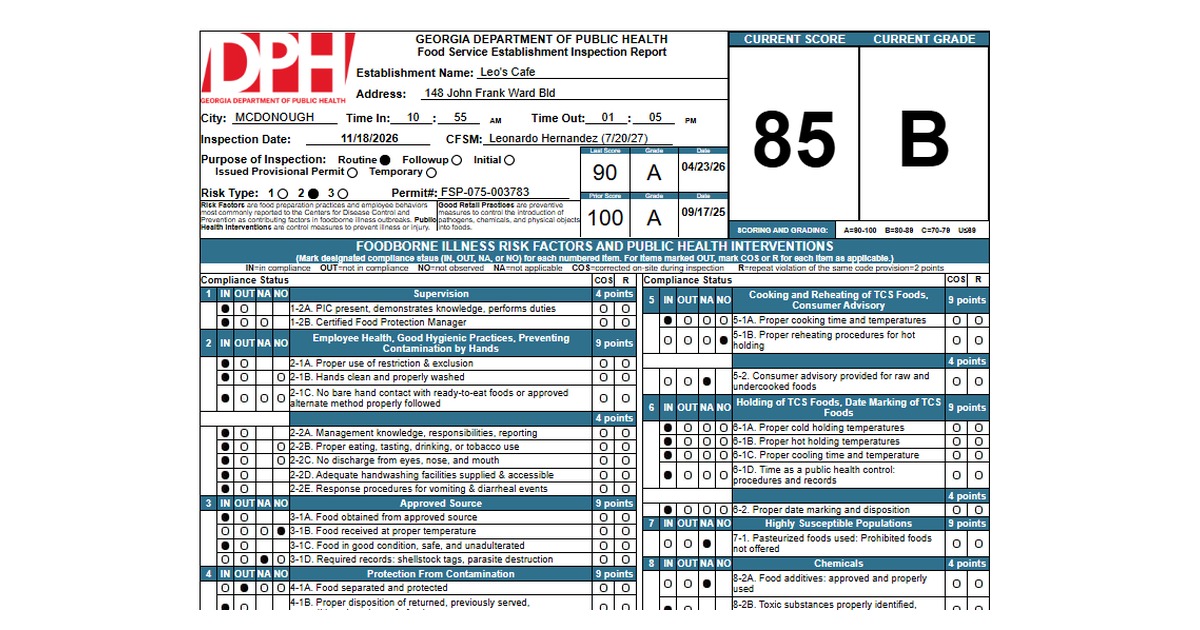
Leo’s Cafe received a score of 85 and a grade of B during a Georgia Department of Public Health inspection conducted November 18, 2026. The score reflects conditions observed during that inspection.
Inspection details
Establishment: Leo’s Cafe
Location: 148 JOHN FRANK WARD BLD MCDONOUGH, GA 30253, Henry County
Inspection date: November 18, 2026
Inspection purpose: Routine
Score and grade: 85/B
Inspector: Sabrina Young
Permit number: FSP-075-003783
Inspection findings
4-1A – food separated and protected
Rule citation: 511-6-1.04(4)(c)1(i)(ii)(iii)(v)(vi)(vii)(viii) – packaged & unpackaged food separation, packaging, and segregation (p, c)
Official point value: 9
Corrected during inspection: No
Repeat violation: No
Inspector notes and corrective action: Observed deli meat stored next to raw fish (Swai) in the walk in cooler. Observed raw burgers stored next to raw chicken breast in the reach in cooler. Several boxes of raw chicken were being prepared above sauces and clean dishes in the food preparation area. 511-6-1.04(4)(c)1(i)(ii)(iii)(v)(vi)(vii)(viii) – Packaged & Unpackaged Food Separation, Packaging, and Segregation (P, C) (c) Packaged and Unpackaged Food – Separation, Packaging, and Segregation. 1. Food shall be protected from cross contamination by: (i) Except as specified in paragraph (i)(IV) of this subsection, separating raw animal foods during storage, preparation, holding, and display from: (I) Raw ready-to-eat food including other raw animal food such as fish for sushi or molluscan shellfish, or other raw ready-to-eat food such as fruits and vegetables, P and (II) Cooked ready-to-eat food; and P (III) Fruits and vegetables before they are washed; P (IV) Frozen, commercially processed and packaged raw animal food may be stored or displayed with or above frozen, commercially processed and packaged, ready-to-eat food. (ii) Except when combined as ingredients, separating types of raw animal foods from each other such as beef, fish, lamb, pork, and poultry during storage, preparation, holding, and display by: (I) Using separate equipment for each type, P or (II) Arranging each type of food in equipment so that cross contamination of one type with another is prevented, P and (III) Preparing each type of food at different times or in separate areas; P (iii) Cleaning and sanitizing equipment and utensils; (v) Cleaning hermetically sealed containers of food of visible soil before opening; (vi) Protecting food containers that are received packaged together in a case or overwrap from cuts when the case or overwrap is opened; (vii) Storing damaged, spoiled, or recalled food being held in the food service establishment separate from food, equipment, utensils, linens and single-service and single-use articles; or (viii) Separating fruits and vegetables, before they are washed from ready-to-eat food.
4-2B – food-contact surfaces: cleaned & sanitized
Rule citation: 511-6-1.05(7)(b) – food contact surfaces and utensils – cleaning frequency (p, c)
Official point value: 4
Corrected during inspection: No
Repeat violation: No
Inspector notes and corrective action: Observed the dishwasher did not meet the minimum requirements for chlorine during the final rinse cycle. The chlorine sanitizing solution was observed at 10 ppm. PIC primed the machine as a corrective action. Once corrected the sanitizer was observed at 50 ppm. 511-6-1.05(7)(b) – Food Contact Surfaces and Utensils – Cleaning Frequency (P, C) (b) Equipment Food-Contact Surfaces and Utensils. 1. Equipment food-contact surfaces and utensils shall be cleaned: (i) Before each use with a different type of raw animal food such as beef, fish, lamb, pork, or poultry. It does not apply if the food-contact surface or utensil is in contact with a succession of different types of raw meat and raw poultry each requiring a higher cooking temperature as specified under DPH Rule 511-6-1.04(5)(a) than the previous type such as preparing raw pork followed by cutting raw poultry on the same cutting board; P (ii) Each time there is a change from working with raw foods to working with ready-to-eat foods; P (iii) Between uses with raw fruits and vegetables and with Time/Temperature Control for safety food; P (iv) Before using or storing a food temperature measuring device; P and (v) At any time during the operation when contamination may have occurred. P 2. Except as specified in paragraph 3 of this subsection, if used with time/temperature control for safety food, equipment food-contact surfaces and utensils shall be cleaned at least every 4 hours throughout the day. P 3. Surfaces of utensils and equipment contacting time/temperature control for safety food may be cleaned less frequently than every 4 hours if: (i) In storage, containers of time/temperature control for safety food and their contents are maintained at temperatures specified under DPH Rule 511-6-1-.04 and the containers are cleaned when they are empty; (ii) Utensils and equipment are used to prepare food in a refrigerated room or area that is maintained at one of the temperatures in the following chart and: (I) The utensils and equipment are cleaned at the frequency in the following chart that corresponds to the temperature: Temperature Cleaning Frequency 41ºF (5.0ºC) or less 24 hours >41ºF – 45ºF (>5.0ºC – 7.2ºC) 20 hours >45ºF – 50ºF (>7.2ºC – 10.0ºC) 16 hours >50ºF – 55ºF (>10.0ºC – 12.8ºC) 10 hours and (II) The cleaning frequency based on the ambient temperature of the refrigerated room or area is documented in the food service establishment. (iii) Temperature measuring devices are maintained in contact with food, such as when left in a container of deli food or in a roast, held at temperatures specified under DPH Rule 511-6-1- .04; (iv) Equipment is used for storage of packaged or unpackaged food, such as a reach-in refrigerator, and the equipment is cleaned at a frequency necessary to preclude accumulation of soil residues; (v) The cleaning schedule is approved based on consideration of: (I) Characteristics of the equipment and its use, (II) The type of food involved, (III) The amount of food residue accumulation, and (IV) The temperature at which the food is maintained during the operation and the potential for the rapid and progressive multiplication of pathogenic or toxigenic microorganisms that are capable of causing foodborne disease; or (vi) In-use utensils are intermittently stored in a container of water in which the water is maintained at 135ºF (57ºC) or more and the utensils and container are cleaned at least every 24 hours or at a frequency necessary to preclude accumulation of soil residues. 4. Dining counters and table-tops shall be cleaned and sanitized routinely after removing all soiled tableware and food trays shall be cleaned and sanitized after each use by one of the following methods: (i) A two step method in which one cloth, rinsed in sanitizing solution is used to clean food debris from the surface and a second cloth in separate sanitizing solution is used to rinse; (ii) Sanitizing solution is sprayed onto the surface and the surface is then wiped clean with a disposable towel; (iii) If used for cleaning and sanitizing, single-use disposable sanitizer wipes shall be used in accordance with EPA-registered label use instructions; or (iv) Other methods approved by the Health Authority. (v) Food trays may be cleaned and sanitized the same as table ware. 5. Except when dry cleaning methods are used as specified under subsection (7)(e) of this Rule, surfaces of utensils and equipment contacting food that is not time/temperature control for safety food shall be cleaned: (i) At any time when contamination may have occurred; (ii) At least every 24 hours for iced tea dispensers including nozzles and consumer self-service utensils such as tongs, scoops, or ladles; (iii) Before restocking consumer self-service equipment and utensils such as condiment dispensers and display containers; and (iv) In equipment such as ice bins and beverage dispensing nozzles and enclosed components of equipment such as ice makers, cooking oil storage tanks and distribution lines, beverage and syrup dispensing lines or tubes, coffee bean grinders, and water vending equipment: (I) At a frequency specified by the manufacturer; or (II) Absent manufacturer specifications, at a frequency necessary to preclude accumulation of soil or mold.
15A – food and nonfood-contact surfaces cleanable, properly designed, constructed, and used
Rule citation: 511-6-1.05(2)(c) – multiuse food-contact surfaces (pf)
Official point value: 1
Corrected during inspection: No
Repeat violation: No
Inspector notes and corrective action: Observed a cracked lid on the walnut storage container. PIC advised to discard due to the potential physical hazard. 511-6-1.05(2)(c) – Multiuse Food-Contact Surfaces (Pf) (c) Multiuse Food-Contact Surfaces. 1. Multiuse food-contact surfaces shall be: (i) Smooth; Pf (ii) Free of breaks, open seams, cracks, chips, inclusions, pits, and similar imperfections; Pf (iii) Free of sharp internal angles, corners, and crevices; Pf (iv) Finished to have smooth welds and joints; Pf and (v) Except as specified in paragraph 2 of this subsection, accessible for cleaning and inspection by one of the following methods: (I) Without being disassembled, Pf (II) By disassembling without the use of tools, Pf or (III) By easy disassembling with the use of handheld tools commonly available to maintenance and cleaning personnel such as screwdrivers, pliers, open-end wrenches, and Allen wrenches. Pf 2. The requirement in paragraph 1(v) of this subsection does not apply to cooking oil storage tanks, Distribution lines for cooking oils, or beverage syrup lines or tubes.
15C – nonfood-contact surfaces clean
Rule citation: 511-6-1.05(7)(d) – nonfood-contact surfaces (c)
Official point value: 1
Corrected during inspection: No
Repeat violation: No
Inspector notes and corrective action: Observed dark accumulation on walk in cooler fans. PIC will clean the fans by 11/19/26. 511-6-1.05(7)(d) – Nonfood-Contact Surfaces (C) (d) Nonfood-Contact Surfaces. Nonfood-contact surfaces of equipment shall be cleaned at a frequency necessary to preclude accumulation of soil residues.
17D – adequate ventilation and lighting; designated areas used
Rule citation: 511-6-1.07(4)(b) – designated areas for employee activity, located to prevent contamination of food, equipment, utensils, linens, & single service articles (c)
Official point value: 1
Corrected during inspection: Yes
Repeat violation: No
Inspector notes and corrective action: Observed employee cup (single-use and lid) stored on top of the reach in cooler (prep area). All employee items should be stored in a designated area to avoid contamination. The cup was discarded (COS). 511-6-1.07(4)(b) – Designated Areas for Employee Activity, located to prevent contamination of food, equipment, utensils, linens, & single service articles (C) (b) Designated Areas for Employee Activity. 1. Areas designated for employees to eat, drink, use tobacco products and electronic devices shall be located so that food, equipment, linens, and single-service and single-use articles are protected from contamination. 2. Lockers or other suitable facilities shall be located in a designated room or area where contamination of food, equipment, utensils, linens and single-service and single-use articles cannot occur.
General inspector comments
Inspection conducted with EHS IV, Robert Lewis. Facility is using TPHC on the following: Raw shelled eggs, pooled eggs, and chicken tenders.
About the report
The Georgia Department of Public Health report documents conditions observed during this inspection. The score should not be interpreted as a guarantee of conditions before or after the inspection.
Marcus Jones
News Now Georgia
More Henry County Food Safety Scores
View All Henry County Food Safety Scores


