
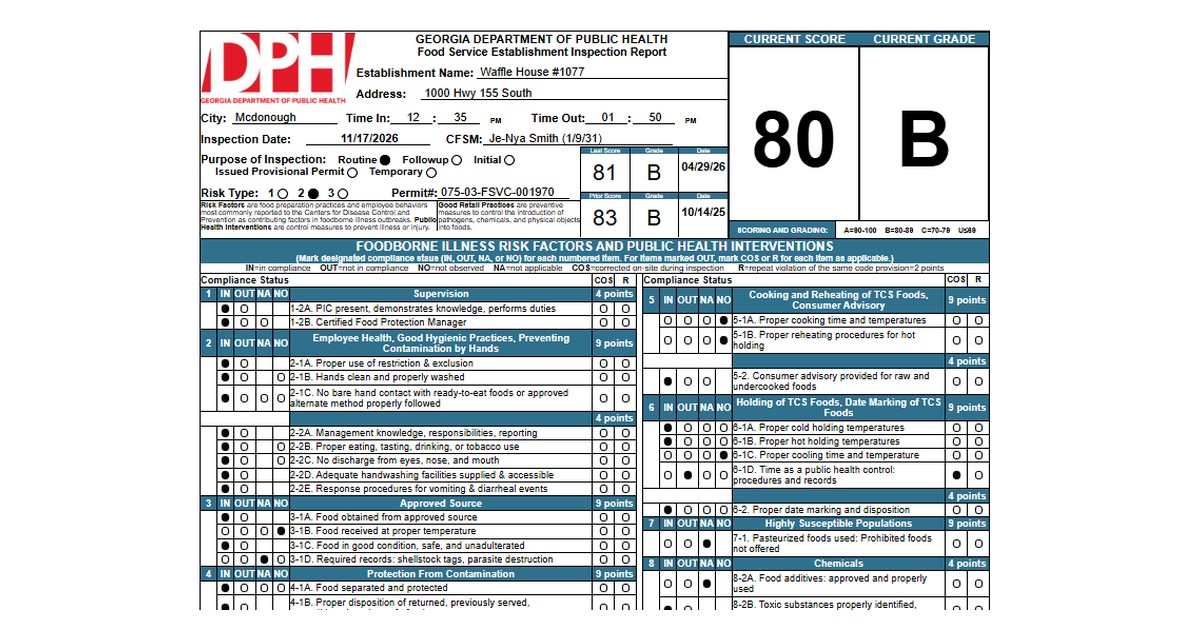
Waffle House #1077 received a score of 80 and a grade of B during a Georgia Department of Public Health inspection conducted November 17, 2026. The score reflects conditions observed during that inspection.
Inspection details
Establishment: Waffle House #1077
Location: 1000 HWY 155 SOUTH MCDONOUGH, GA 30253, Henry County
Inspection date: November 17, 2026
Inspection purpose: Routine
Score and grade: 80/B
Inspector: Rachel Williams
Permit number: 075-03-FSVC-001970
Inspection findings
4-2B – food-contact surfaces: cleaned & sanitized
Rule citation: 511-6-1.05(7)(b) – food contact surfaces and utensils – cleaning frequency (p, c)
Official point value: 4
Corrected during inspection: No
Repeat violation: No
Inspector notes and corrective action: Observed black accumulation on diffuser of drink machine, dishes with food accumulation, and black staining on deflector if ice machine. 511-6-1.05(7)(b) – Food Contact Surfaces and Utensils – Cleaning Frequency (P, C) (b) Equipment Food-Contact Surfaces and Utensils. 1. Equipment food-contact surfaces and utensils shall be cleaned: (i) Before each use with a different type of raw animal food such as beef, fish, lamb, pork, or poultry. It does not apply if the food-contact surface or utensil is in contact with a succession of different types of raw meat and raw poultry each requiring a higher cooking temperature as specified under DPH Rule 511-6-1.04(5)(a) than the previous type such as preparing raw pork followed by cutting raw poultry on the same cutting board; P (ii) Each time there is a change from working with raw foods to working with ready-to-eat foods; P (iii) Between uses with raw fruits and vegetables and with Time/Temperature Control for safety food; P (iv) Before using or storing a food temperature measuring device; P and (v) At any time during the operation when contamination may have occurred. P 2. Except as specified in paragraph 3 of this subsection, if used with time/temperature control for safety food, equipment food-contact surfaces and utensils shall be cleaned at least every 4 hours throughout the day. P 3. Surfaces of utensils and equipment contacting time/temperature control for safety food may be cleaned less frequently than every 4 hours if: (i) In storage, containers of time/temperature control for safety food and their contents are maintained at temperatures specified under DPH Rule 511-6-1-.04 and the containers are cleaned when they are empty; (ii) Utensils and equipment are used to prepare food in a refrigerated room or area that is maintained at one of the temperatures in the following chart and: (I) The utensils and equipment are cleaned at the frequency in the following chart that corresponds to the temperature: Temperature Cleaning Frequency 41ºF (5.0ºC) or less 24 hours >41ºF – 45ºF (>5.0ºC – 7.2ºC) 20 hours >45ºF – 50ºF (>7.2ºC – 10.0ºC) 16 hours >50ºF – 55ºF (>10.0ºC – 12.8ºC) 10 hours and (II) The cleaning frequency based on the ambient temperature of the refrigerated room or area is documented in the food service establishment. (iii) Temperature measuring devices are maintained in contact with food, such as when left in a container of deli food or in a roast, held at temperatures specified under DPH Rule 511-6-1- .04; (iv) Equipment is used for storage of packaged or unpackaged food, such as a reach-in refrigerator, and the equipment is cleaned at a frequency necessary to preclude accumulation of soil residues; (v) The cleaning schedule is approved based on consideration of: (I) Characteristics of the equipment and its use, (II) The type of food involved, (III) The amount of food residue accumulation, and (IV) The temperature at which the food is maintained during the operation and the potential for the rapid and progressive multiplication of pathogenic or toxigenic microorganisms that are capable of causing foodborne disease; or (vi) In-use utensils are intermittently stored in a container of water in which the water is maintained at 135ºF (57ºC) or more and the utensils and container are cleaned at least every 24 hours or at a frequency necessary to preclude accumulation of soil residues. 4. Dining counters and table-tops shall be cleaned and sanitized routinely after removing all soiled tableware and food trays shall be cleaned and sanitized after each use by one of the following methods: (i) A two step method in which one cloth, rinsed in sanitizing solution is used to clean food debris from the surface and a second cloth in separate sanitizing solution is used to rinse; (ii) Sanitizing solution is sprayed onto the surface and the surface is then wiped clean with a disposable towel; (iii) If used for cleaning and sanitizing, single-use disposable sanitizer wipes shall be used in accordance with EPA-registered label use instructions; or (iv) Other methods approved by the Health Authority. (v) Food trays may be cleaned and sanitized the same as table ware. 5. Except when dry cleaning methods are used as specified under subsection (7)(e) of this Rule, surfaces of utensils and equipment contacting food that is not time/temperature control for safety food shall be cleaned: (i) At any time when contamination may have occurred; (ii) At least every 24 hours for iced tea dispensers including nozzles and consumer self-service utensils such as tongs, scoops, or ladles; (iii) Before restocking consumer self-service equipment and utensils such as condiment dispensers and display containers; and (iv) In equipment such as ice bins and beverage dispensing nozzles and enclosed components of equipment such as ice makers, cooking oil storage tanks and distribution lines, beverage and syrup dispensing lines or tubes, coffee bean grinders, and water vending equipment: (I) At a frequency specified by the manufacturer; or (II) Absent manufacturer specifications, at a frequency necessary to preclude accumulation of soil or mold.
6-1D – time as a public health control: procedures and records
Rule citation: 511-6-1.04(6)(i) – time as a public health control (tphc) (p, pf, c)
Official point value: 9
Corrected during inspection: Yes
Repeat violation: No
Inspector notes and corrective action: Observed eggs with a discard of time of 10 AM. PIC discarded of eggs. 511-6-1.04(6)(i) – Time as a Public Health Control (TPHC) (P, Pf, C) (i) Time as a Public Health Control. 1. Except as specified under paragraph 4 of this subsection, if time without temperature control is used as the public health control for a working supply of time/temperature control for safety food before cooking, or for ready-to-eat time/temperature control for safety food that is displayed or held for sale or service, written procedures shall be prepared in advance, maintained in the food service establishment, and made available to the regulatory authority upon request that specify: Pf (i) Methods of compliance with paragraphs 2(i) – (iv) or 3(i) through (v) of this subsection; and (ii) Methods of compliance with the cooling of time/temperature control for safety food that is prepared, cooked, and refrigerated before time is used as a public health control. Pf 2. If time without temperature control is used as the public health control up to a maximum of 4 hours: (i) Except as specified in paragraph 2.(ii) of this subsection, the food shall have an initial temperature of 41°F (5°C) or less when removed from cold holding temperature control, or 135°F (57°C) or greater when removed from hot holding temperature control;P (ii) The food may have an initial temperature of 70°F (21°C) or less if; (I) It is a ready-to-eat fruit or vegetable that upon cutting is rendered a time/temperature control for safety food, or (II) It is a ready-to-eat hermetically sealed food that upon opening is rendered a time/temperature control for safety food, (III) The food temperature does not exceed 70°F (21°C) within a maximum time period of 4 hours from the time it was rendered a time/temperature control for safety food; and (IV) The food is marked or otherwise identified to indicate the time that is 4 hours past the point in time when the food is rendered a time/temperature control for safety food as specified in paragraph 2.(ii)(I) and (II). (iii) The food shall be marked or otherwise identified to indicate the time that is 4 hours past the point in time when the food is removed from temperature control;Pf (iv) The food shall be cooked and served, served at any temperature if ready-to-eat, or discarded, within 4 hours from the point in time when the food is removed from temperature control;P and (v) The food in unmarked containers or packages, or marked to exceed a 4-hour limit shall be discarded.P 3. If time without temperature control is used as the public health control up to a maximum of 6 hours: (i) The food shall have an initial temperature of 41°F (5°C) or less when removed from temperature control and the food temperature may not exceed 70°F (21°C) within a maximum time period of 6 hours; P (ii) The food shall be monitored to ensure the warmest portion of the food does not exceed 70°F (21°C) during the 6-hour period, unless an ambient air temperature is maintained that ensures the food does not exceed 70°F (21°C) during the 6-hour holding period; Pf (iii) The food shall be marked or otherwise identified to indicate: Pf (I) The time when the food is removed from 41°F (5°C) or less cold holding temperature control, Pf and (II) The time that is 6 hours past the point in time when the food is removed from cold holding temperature control; (iv) The food shall be: (I) Discarded if the temperature of the food exceeds 70°F (21°C), P or (II) Cooked and served, served at any temperature if ready-to-eat, or discarded within a maximum of 6 hours from the point in time when the food is removed from 41°F (5°C) or less cold holding temperature control; P and (v) The food in unmarked containers or packages, or marked with a time that exceeds the 6-hour limit shall be discarded. P 4. A food service establishment that serves a highly susceptible population may not use time as the public health control for raw eggs.
12C – wiping cloths: properly used and stored
Rule citation: 511-6-1.04(4)(m) – wiping cloths, use limitation (c)
Official point value: 3
Corrected during inspection: Yes
Repeat violation: No
Inspector notes and corrective action: Observed wet wiping cloths stored in sanitizer solution below proper minimum concentration. Employees remade sanitizer solution. 511-6-1.04(4)(m) – Wiping Cloths, Use Limitation (C) (m) Wiping Cloths, Use Limitation. 1. Cloths in-use for wiping food spills from tableware and carry-out containers that occur as food is being served shall be: (i) Maintained dry; and (ii) Used for no other purpose. 2. Cloths in-use for wiping counters and other equipment surfaces shall be: (i) Held between uses in a chemical sanitizer solution at a concentration specified under DPH Rule 511-6-1-.05(6)(n); and (ii) Laundered daily. 3. Cloths in-use for wiping surfaces in contact with raw animal foods shall be kept separate from cloths used for other purposes. 4. Dry wiping cloths and the chemical sanitizing solutions in which wet wiping cloths are held between uses shall be free of food debris and visible soil. 5. Containers of chemical sanitizing solutions in which wet wiping cloths are held between uses shall be stored off the floor and used in a manner that prevents contamination of food, equipment, utensils, linens, single-service, or single-use articles. 6. Single-use disposable sanitizer wipes shall be used in accordance with EPA-approved manufacturer’s label use instructions.
15C – nonfood-contact surfaces clean
Rule citation: 511-6-1.05(7)(a)2,3 – equipment, food/nonfood-contact surfaces, and utensils, food-contact surfaces of cooking equipment & nonfood-contact surfaces free of accumulations (c)
Official point value: 1
Corrected during inspection: No
Repeat violation: No
Inspector notes and corrective action: Observed liquid accumulation at bottom of reach-in cooler, drawers containing cleaned utensils with food debris, and ice accumulation around the walk-in freezer door. 511-6-1.05(7)(a)2,3 – Equipment, Food/Nonfood-Contact Surfaces, and Utensils, food-contact surfaces of cooking equipment & nonfood-contact surfaces free of accumulations (C) 2. The food-contact surfaces of cooking equipment and pans shall be kept free of encrusted grease deposits and other soil accumulations. 3. Nonfood-contact surfaces of equipment shall be kept free of an accumulation of dust, dirt, food residue, and other debris.
16B – plumbing installed; proper backflow devices
Rule citation: 511-6-1.06(2)(r) – system maintained in good repair (p, c)
Official point value: 2
Corrected during inspection: No
Repeat violation: No
Inspector notes and corrective action: Observed walk-in freezer refrigeration unit with evidence of leading (ice accumulation on piping). 511-6-1.06(2)(r) – System Maintained in Good Repair (P, C) (r) System Maintained in Good Repair. A plumbing system shall be repaired according to law; P and maintained in good repair.
17A – toilet facilities: properly constructed, supplied, cleaned
Rule citation: 511-6-1.07(5)(h) – cleaning plumbing fixtures- handsinks, urinals & toilets (c)
Official point value: 1
Corrected during inspection: No
Repeat violation: No
Inspector notes and corrective action: Observed accumulation in toilets in women’s and men’s restroom. 511-6-1.07(5)(h) – Cleaning Plumbing Fixtures- Handsinks, Urinals & Toilets (C) (h) Cleaning of Plumbing Fixtures. Plumbing fixtures such as handwashing sinks, toilets, and urinals shall be cleaned as often as necessary to keep them clean and maintained.
17A – toilet facilities: properly constructed, supplied, cleaned
Rule citation: 511-6-1.06(5)(h) – toilet room receptacle, covered (c)
Official point value: 1
Corrected during inspection: No
Repeat violation: No
Inspector notes and corrective action: Observed no covered receptacle in women’s restroom. 511-6-1.06(5)(h) – Toilet Room Receptacle, Covered (C) (h) Toilet Room Receptacle, Covered. A toilet room used by females shall be provided with a covered receptacle for sanitary napkins.
17A – toilet facilities: properly constructed, supplied, cleaned
Rule citation: 511-6-1.07(2)(l) – toilet rooms, enclosed (c)
Official point value: 1
Corrected during inspection: No
Repeat violation: No
Inspector notes and corrective action: Observed self-closing restroom doors not properly closing. 511-6-1.07(2)(l) – Toilet Rooms, Enclosed (C) (l) Toilet Rooms, Enclosed. Except where a toilet room is located outside a food service establishment and does not open directly into the food service establishment, such as a toilet room that is provided by the management of a shopping mall, a toilet room located on the premises shall be completely enclosed and provided with a tight-fitting and self-closing door.
General inspector comments
Please provide documentation of the repair of the walk-in freezer refrigeration unit to rachel.williams@dph.ga.gov by 12/4/26.
About the report
The Georgia Department of Public Health report documents conditions observed during this inspection. The score should not be interpreted as a guarantee of conditions before or after the inspection.
Marcus Jones
News Now Georgia
More Henry County Food Safety Scores
View All Henry County Food Safety Scores


